


{{'Newsletter' | t}}
HKU-led JWST Proposal "COHORTS" Marks Historic First for Hong Kong in Cosmic Lensing Research

[Figure] The Cosmic Horseshoe imaged by the Hubble Space Telescope. The background, strongly magnified starburst galaxy is deflected by the foreground passive galaxy in the centre into the shape of a horseshoe. The COHORTS programme will observe this same system infrared regime with ten times higher sensitivity to search for lensed stars.
A research team led by HKU has secured observing time on the James Webb Space Telescope (JWST) for Cycle 5—a highly competitive process in which only 9% of proposals are accepted. The programme, COHORTS (COsmic HORseshoe Transient Survey), is led by Sung Kei Li, a PhD student in the Department of Physics, supervised by Professor Jeremy Lim, and involves 27 collaborators from around the world. This is the first time a proposal submitted by a Hong Kong university has been accepted for JWST observing time among the 1,300 proposals received since the telescope’s commissioning.
The first systematic search for lensed stars in a galaxy-galaxy strong lensing system, with HKU leading the way
Gravitational lensing occurs when a foreground galaxy bends and magnifies light from a more distant galaxy. In rare cases, individual stars in that distant galaxy—normally far too faint to see—become temporarily detectable, known as lensed stars. The team will observe the “Cosmic Horseshoe” as shown in the figure above, a starburst galaxy from the cosmic noon era, when the Universe was 2.7 billion years old and forming stars at its highest rate. The horseshoe’s extreme star formation and ring-like shape make it ideal for finding lensed stars.
The observations will address two major astrophysical issues. First, dark matter makes up 85% of the universe's mass, but its true nature is unknown. The two leading candidates—heavy particles or ultra-light waves—predict different patterns of where lensed stars appear. Second, the formation rate of massive stars relative to smaller ones, known as the stellar initial mass function (IMF), is crucial for galaxy evolution models, but current models assuming the universality of the IMF overpredict the number of massive galaxies in the early universe. The previous measurements of IMF are confined to our local universe as individual stars further away could not have been observed, whereas HKU-led work has shown that the detection rate of lensed stars is a unique way of measuring the IMF beyond our local universe. Lensed stars revealed by the COHORTS programme will allow for testing the nature of dark matter, and constraining the stellar IMF at the cosmic noon through lensed stars.
Exploring the Universe’s invisible scaffolding
“My research is motivated by some of the open questions in the ΛCDM model—the standard ‘recipe’ for our universe,” Sung Kei shares. “The model has been remarkably successful, but it still leaves a few puzzles unsolved, particularly around the nature of dark matter and the unexpectedly large number of massive galaxies seen in the early universe by the JWST.”
To explore these questions, Sung Kei tries to make use of a rare observational phenomenon: extremely magnified stars. Thanks to gravitational lensing—where massive foreground objects act as natural cosmic magnifying glasses—it is sometimes possible to detect individual stars across vast cosmological distances. “My early work hints that the spatial distribution of these stars might help us distinguish between different dark matter candidates, such as ultra-light axions and WIMPs. I also attempt to use these detection rates to learn about the stellar IMF, and to ask whether the early universe might have formed stars differently than it does today.”
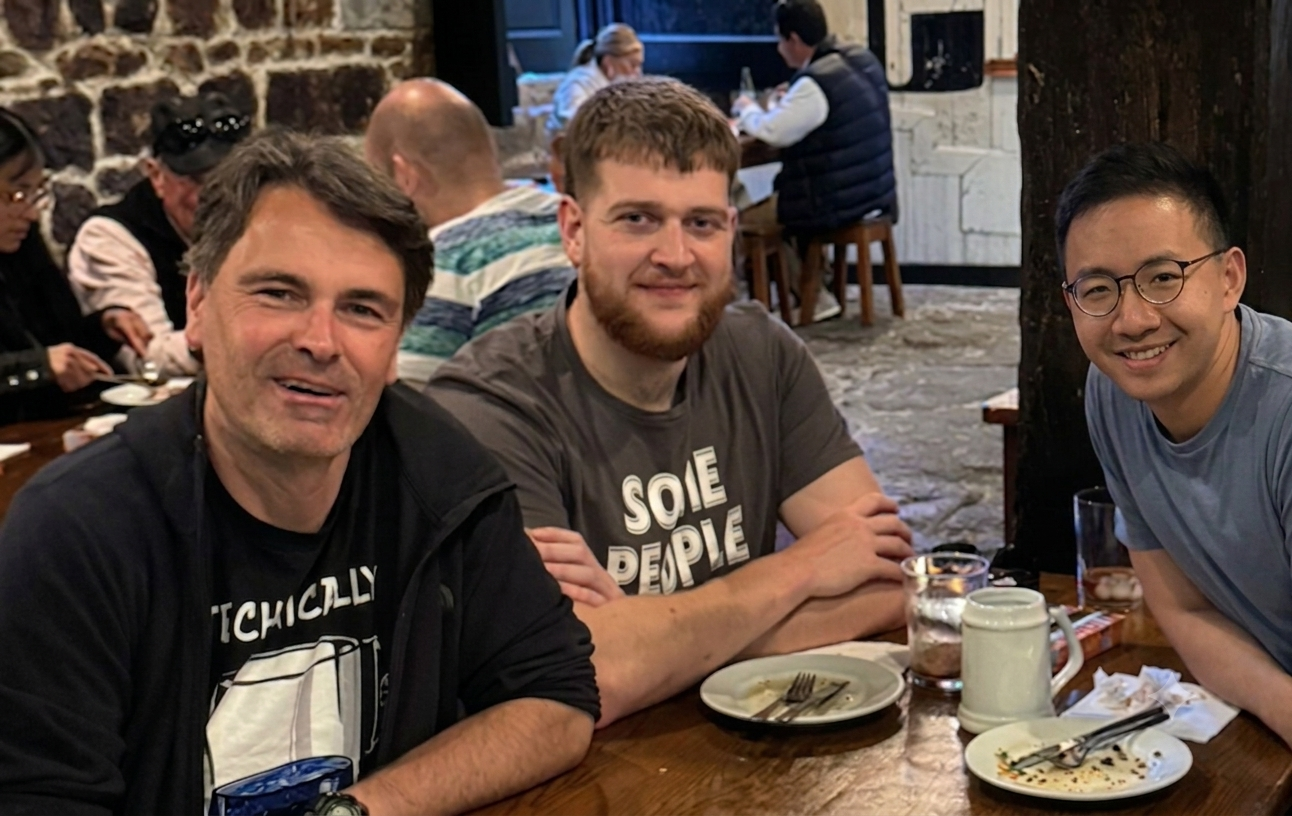
Sung Kei Li (right), Dr. Jose Diego, Co-PI of COHORTS and Sung Kei's host for his croucher fellowship (left),
and Jose Palencia, Dr. Diego's PhD student and Co-I of COHORTS (middle)
With this remarkable achievement, Sung Kei has recently been awarded the Croucher Fellowship issued by the Croucher Foundation.
“Being the first Hong Kong-based PI for a JWST programme was a proud and unexpected moment, and this fellowship encourages me to keep trying to bring some international scientific visibility to the region,” Sung Kei remarks. "This recognition is not just a personal milestone; it reflects the generous support of a wonderful scientific community that has nurtured my curiosity."
“This journey would not have been possible without the unwavering support of my mentors and colleagues. I would like to express my deepest gratitude to the Croucher Foundation for their visionary support; to Professor Jeremy Lim at HKU for his patient guidance and mentorship throughout my undergraduate and doctoral studies; to Dr Jose Maria Diego at the Instituto de Física de Cantabria (IFCA) for his expert co-supervision and for kindly welcoming me into the research community in Spain; to Professor Thomas Broadhurst at Donostia International Physics Center (DIPC) for his insightful co-supervision and contributions to my academic growth; and to HKU for providing the environment where my research could find its footing.”
Beginning in August 2026, the fellowship will take Sung Kei to IFCA in Spain, where he will continue to explore the Universe and collaborate with others who share that curiosity.