
{{'Newsletter' | t}}
Junjie Zhao: Pioneering Research in Biomedical Imaging and Dental AI
%20(1).png)
Junjie Zhao is a Year 2 PhD student of the HKU-BICI (Beijing Institute of Collaborative Innovation) Entrepreneurship Joint Educational Placement Programme under the co-supervision of Professor Junwen Wang from HKU’s Faculty of Dentistry and Professor Liangyi Chen from Peking University. Junjie joined HKU in 2024. With a prior background in computer science, he began—under the supervision of the two professors, respectively explore the research fields of biomedical imaging analysis of living cells and multimodal AI reasoning in dentistry.
In the early stages of his doctoral research, Junjie faced multiple technical challenges, such as how to process large-scale in vivo biomedical imaging data of neuronal activity for neural network construction and network decomposition, as well as how to develop multimodal large language models suitable for clinical scenarios. Through numerous rounds of experimental iteration—under the patient guidance of Professor Wang, Professor Chen, and a researcher from Peking University, Changliang Guo, and with strong collaboration from partners including Dr Xiang Liu, Dongzhou Gou, Chao Song, and others—he developed the structural–functional calibration method. This method corrects axial overcounting and network distortion in volumetric calcium imaging, and, combined with an in-house developed model, significantly improves the accuracy and speed of neuronal network construction and decomposition analysis from in vivo super-resolution imaging data. Additionally, Junjie participated in the project “Cortex-wide single-cell activity mapping in freely moving mice” and proposed COMET (Cortex-wide Observational Miniature Epifluorescence Technique). This technique enables the recording of single-cell activity across the entire dorsal cortex in freely moving mice without interfering with their natural behaviour, allowing researchers to understand how neuronal networks integrate sensory inputs, process information, and drive behaviour.
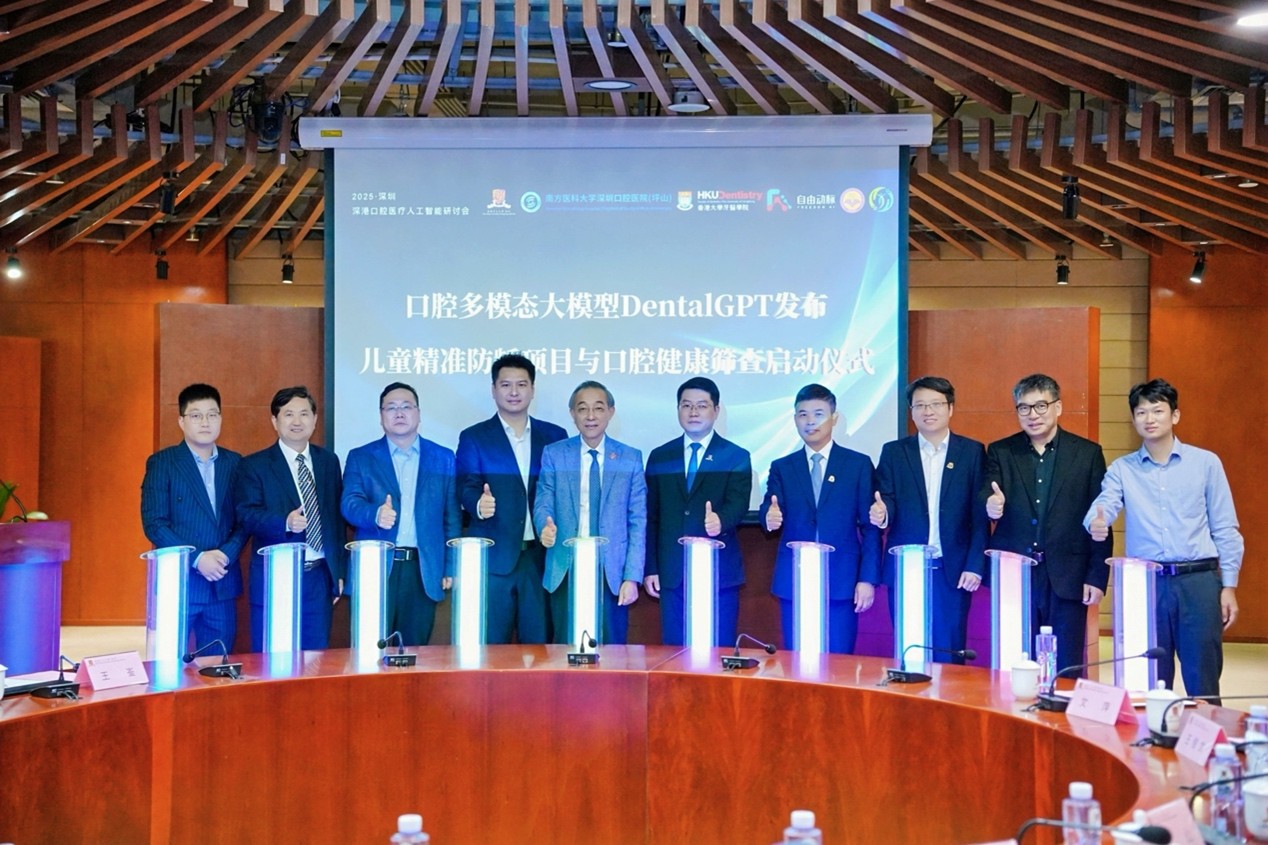
“DentalGPT”, the world’s first dental AI model, was launched at the Shenzhen-Hong Kong Oral Healthcare Artificial Intelligence Seminar on December 4, 2025.
Meanwhile, under the guidance of Professor Wang, Professor Chen, Professor Benyou Wang from the Chinese University of Hong Kong (Shenzhen) and Professor Shan Jiang from Southern Medical University, Junjie took charge of the research and development work for the DentalGPT project. He identified that general-purpose large models exhibit weaknesses in structured reasoning for dental image understanding and struggle to directly align with clinical needs. To address these issues, he collaborated closely with Zhenyang Cai from the Chinese University of Hong Kong (Shenzhen), Jiaming Zhang from the Southern Medical University, and other team members. They trained the model on approximately 120,000 high-quality, multi-source dental images, incorporating expert annotations and reinforcement learning strategies. This enabled the model to go beyond basic recognition tasks (such as tooth counting and lesion localisation) and support more clinically logical complex reasoning. In multiple international and domestic dental imaging benchmark evaluations, DentalGPT currently achieves the highest average score of 67.1, surpassing GPT-5’s score of 59. Its overall performance outperforms existing large commercial multimodal models, demonstrating outstanding potential as a clinical auxiliary tool.
Currently, DentalGPT has achieved initial deployment at Shenzhen Stomatology Hospital (Pingshan) of Southern Medical University, where it is being applied in scenarios such as intelligent triage, 24-hour consultation responses, and the generation of structured diagnostic suggestions, helping to improve daily visit efficiency and enhance patient experience.
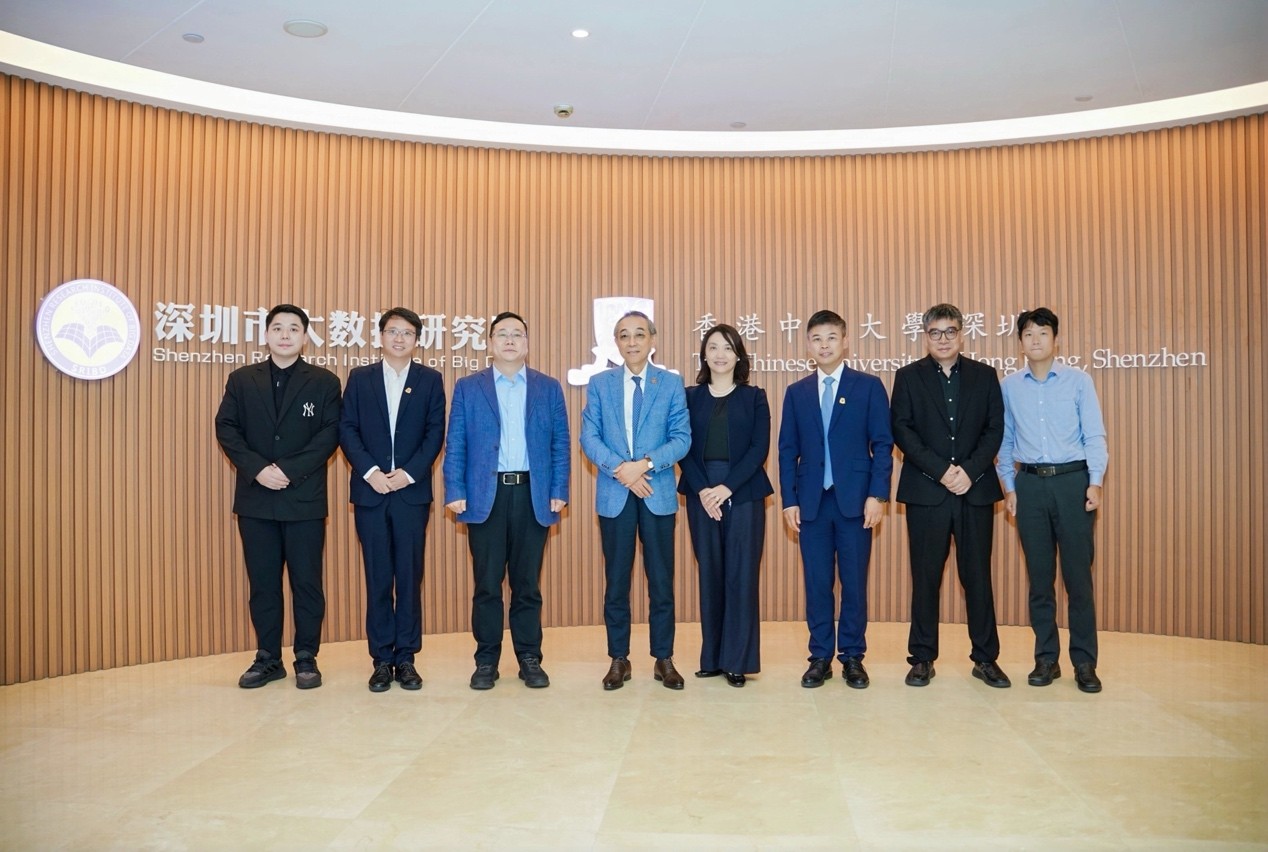
HKU PhD student Junjie Zhao (first from left) joined Professor Lijian Jin, Dean of the Faculty of Dentistry (fourth from left), and his supervisor Professor Junwen Wang (second from right) at the Shenzhen-Hong Kong Oral Healthcare Artificial Intelligence Seminar held at The Chinese University of Hong Kong, Shenzhen.
Life is a continuous journey of learning. In the future, Junjie will continue to advance the parallel exploration of neuroimaging analysis and dental AI applications, hoping that through this work, he can gradually contribute some practical value to the interdisciplinary field of biomedical imaging and clinical AI. Junjie sincerely thanks Professor Wang, Professor Chen, and Changliang Guo for their support and guidance, as well as all collaborators for their help and encouragement.